It is strange to talk about improvements when the product does not
yet exist, but there are a few important ideas that deviate from
original KRunner that I’ve been working on.
I’ve already ported a few of the more important runners in order to
be able to test the infrastucture. While doing this, I’ve been able to
detect a few deficiencies of the current design. So I decided to go over
the design of KRunner and the way it used to generate the results in
order to which parts could be improved.
Reusing the results
In the old KRunner, the user would type a query, and the runners
would generate the results for that query. Now, if you added another
character to the query, the runners would generate all the results for
that new query from scratch.
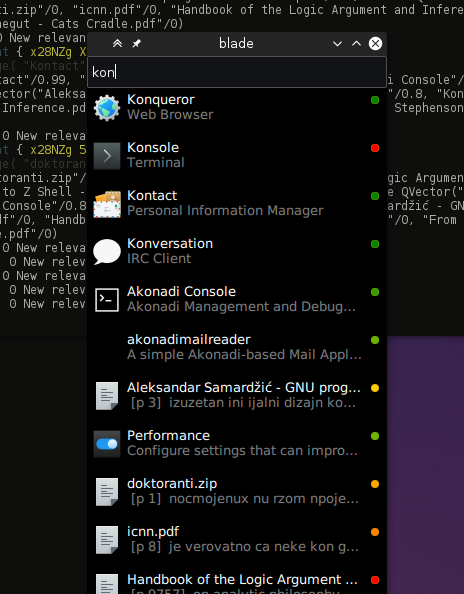
This is suboptimal. When the user types ‘kons’ and gets
Konsole as the result, typing ‘o’ should not remove konsole
from the list only to add it again because it still matches the input
string ‘konso’.
Now each runner can add the whole string it used for matching to the
result. So, in the case of Konsole, it could pass something like
‘Konsole - Terminal’. This way, the GUI part of KRunner will be able to
tell that this result is still relevant and that it should keep it in
the list. Runner that searches for files might even pass a section of
the text where the query appears (this might even be useful to show in
the UI - like Recoll does).
Merging the results
The second thing that I always found strange is that if two different
runners returned the same result, KRunner will show the result twice.
Just enter ‘konsole’, and you will get ‘Konsole’ and ‘Run konsole’.
Now, if two runners return the same thing, the results will be
combined, and the result will get a higher score. Since the score (or
relevance) is a number between 0 and 1, these are combined in a
fun math way used in fuzzy logic.
Result owner
The other problem in KRunner is that each runner is tasked to handle
the results it has created. This means that you might get different
available actions for the same file if it was returned by two different
runners.
So, the second change was to rethink what is a
result in KRunner.
Instead of each runner owning its result, it will now, by default,
only need to explain what the result is. That way, if it is a file, the
GUI will know what actions to provide, if it is an application, the GUI
will know what actions to provide, etc. If it is something unorthodox,
then, and only then, the runner should be asked how to execute it.
When?
It is difficult to predict, but I hope I’ll be able to make a preview
version (called ‘Blade’) by the end of July. The current plan is to
release it as a separate application – for testing purposes only, and
after that I’ll have to go one KRunner feature at a time to make sure it
has no obvious regressions.
The worst part is that, thanks to Kai Uwe, KRunner is now a
moving target and I’ll have to play catch-up with all the features he
adds to main KRunner. :)
In my
previous post, I’ve talked about the idea to split KRunner into a
few separate processes that will execute the different searching plugins
(also known as runners) isolated from one another.
This time, I’m going to talk about the Voy library (framework?) that
was born from this idea and that is still evolving to better suit the
use-cases of KRunner, while also being general enough for a few more
test apps that I build against it.
The Model
The idea is simple – the system should be split into a bunch of
components. Each component should follow the UNIX philosophy – do one
thing, and do it well. The components need to be isolated in the sense
that the only way for two components to interact with each other is by
sending messages – no shared memory, no shared data, nothing – just
messages.
You can think of it like these components were persons. We don’t know
what the next person is thinking about unless he/she tells us.
This approach allows implementing complex systems without any
synchronization primitives like mutexes, and if done well, they lift the
requirement that all components need to be in the same process or even
on the same host. We just need to be able to serialize messages and
transfer them over the network.
This model does introduce complexities in other areas – we need to
think of the program logic in a slightly different way, but it is worth
it.
There are a few libraries that implement this and similar models like
the C++ Actor Framework and SObjectizer, but they have a significantly
different project aims to this one. Still, they are worth checking
out.
The Messaging System
In this model, the messages are crucial, so the most important part
of the Voy library is its message handling.
Like in the real life, in order to communicate with others, we either
need to know to whom we want to pass information, or we can yell to make
sure everybody hears us.
In Voy, this is a bit more granular. Each agent (we will call these
isolated components agents from now on) has an address comprised of
three components:
the unique id of the host it is running on
a unique id of the process instance it belongs to (called a ‘group’
in Voy)
and a unique id of the agent itself
This way, if we know the address, we can send a targeted message to
another agent. We could also choose to send messages to all agents
belonging to a specific group, or to all agents located on a specific
host. This gives us some control, but it is mostly based on the physical
location of the Agent.
Sometimes, we might want to target a specific group of agents that
are not in the same location, but still not to spam other agents with
messages they do not need.
As an example, imagine a community of software developers working on
a huge Free Software project. They are usually located in completely
different parts of the world, but they still belong to the same team.
They should be able to communicate without agents that are not in that
team receiving those messages.
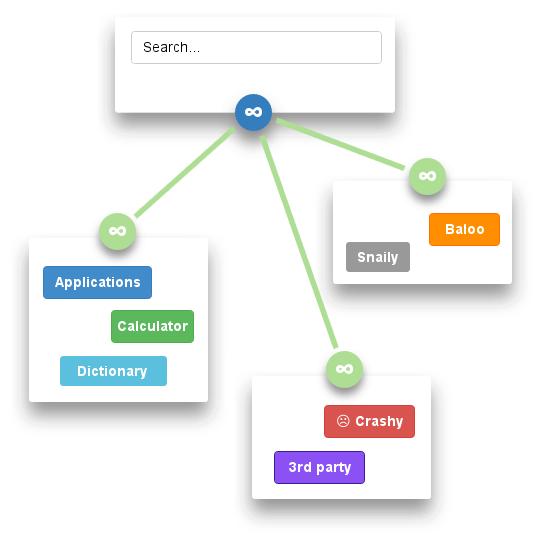
Just for the reminder what distributed KRunner will look
like
This brought named teams to Voy. While everything else is based on
UUIDs, teams have proper names. This means that we are able to split
agents into named groups, and they will be able to communicate even if
they don’t know the addresses of other team members.
This works similar to mailing lists – I don’t need to know mail
addresses of all Plasma developers, but I still can send them an e-mail
through the mailing list.
For improved granularity, sending messages to a team can also be
limited to a specific host or process instance.
KRunner is one of the rare areas of Plasma that have been mostly
stagnating since 4.x, and is one of the rare parts of Plasma that are
still known to crash. At least, the UI has improved in the last few
releases thanks to Kai who rightfully became the new KRunner
maintainer.
Now, while the UI is still getting some love, the backend is mostly
not. During the course of Plasma 5.x development, Aaron had a really
great idea (inspired by his newfound love of Erlang) of creating a more
mature infrastructure for
KRunner that would (among other things) allow it never to block the
UI while calculating the results. Unfortunately, this never got
integrated into KRunner UI for various reasons.
KRunner infrastructure now
KRunner is plugin-based. When the user performs a search, it loads
the plugins and sends them the query data. This allows it to be extended
easily, and it makes it one of the most advanced launchers in the free
world (and proprietary as well).
KRunner today
The downside is that the UI is not isolated from the engine, and the
plugin loading and more advanced searching plugins (runners) can slow
the interface down, and ruin the user experience. Whats even more
problematic, a single misbehaving runner (one that tries to run outside
of the running track) can bring the whole application down.
For this reason, the application menus that use KRunner to power its
search usually white-list only the runners we consider
safe.
KRunner - a new hope
One of the things I’ve been spending my time lately on is a possible
new infrastructure design for KRunner. I took a couple of ideas that
Aaron had (I’m not fond of Erlang as a language, but its communication
model is unbeatable), forgot some of the others, and added a few of my
own.
The idea is to make runners to be simple isolated nodes in the system
that are just able to send and receive messages. Nothing more. Most of
them should not even need to keep any internal state – they just need to
be able to receive a request, and send back the response.
The fact that they share nothing with each other, and with the main
application means that they can all be running in a separate process, or
that different runners can be grouped into a few different processes
based on their speed and stability. They could even all live in the same
process, as long as they do not live in the same process as the UI.
KRunner Future
This architecture will allow the crashy runners to crash as much as
they want, the UI and the rest of the runners will continue their
journey uninterrupted.
Querying other
computers on the network
The fact that components are isolated and that they can live in
separate processes, while only being able to send messages to each other
has one really neat implication: They can even live on separate
computers, and the messages can be exchanged through the local
network.
This will allow the KRunner UI that lives on one computer, to return
results from other computers as well. While this is not really useful
for most runners (the calculator will calculate the same value
regardless of the system it is running on), it would be really useful
for runners like Baloo or Recoll which search the local file-system for
files containing the search phrase. You’d be able to search for files on
as many systems as you desire.
KRunner Future
Naturally, the systems would need to be paired first for privacy
reasons – you will not be able to search through other people’s data if
they did not allow it.
Current status
So far, I’ve been working on the lowest level of the stack – on the
library that will allow easy creation of isolated agents (or peers), and
allow a network-transparent message passing between them. So far, it
works reasonably well, the different instances of the system are able to
discover each other either via KDNSSD framework, or, if it fails as it
often does, via UDP broadcasts and by sharing the ‘contact information’
about other agents to the newly arrived one.
The cool thing is that none of the agents actually know whether they
are talking to an agent from the same process, from the same computer,
or from some other machine on the network.
Plans of mice and men
Now, is this one going to be the new KRunner engine? I hope so, but
it first needs to become mature enough to even be considered as a
replacement.
I’ll post progress updates from time to time, and screenshots when I
actually manage to hack it into the KRunner UI. :)
One thing that always thrilled me is the idea that physics today is
quite similar to software bugs triaging. You have a currently (or
previously) accepted theory, and you make experiments that will show
that the reality sometimes does not work according to that theory.
That is essentially what happens at CERN and the CMS experiment.
There were suspicions (theories) that the universe contains more types
of particles than we supposed at some time. In order to show that,
physicists decided to build a large particle collider and measure
monitor for events that don’t fit the previously accepted theories.
Now, when these ‘bugs’ in the fabric of reality are found, the
scientists do not try to fix them (you can’t change reality), but rather
to make a mathematical model that describes the real world better than
the last one.
KDE CERN
Fixing bugs in Plasma
This is where software developers differ. We also try to make
collisions which will expose problems in our software, but we are
allowed to change the reality and fix the bugs instead of ‘just’ writing
a new specification of our programs that includes the bugs as its
essential parts.
My main task at the Plasma sprint we had in CERN was to actually
perform as many collisions I can with the activity switcher, and fix all
the bugs that I could find. Sometimes the collisions exposed issues
outside the switcher – in other parts of Plasma.
I am glad that I can say that I’ve fixed quite a few issues where
most were not previously known. Plasma 5.6 will have a more streamlined
activity switcher than it used to because its back-end was completely
revamped, and it will be much more stable thanks to all the bugs that
went away.
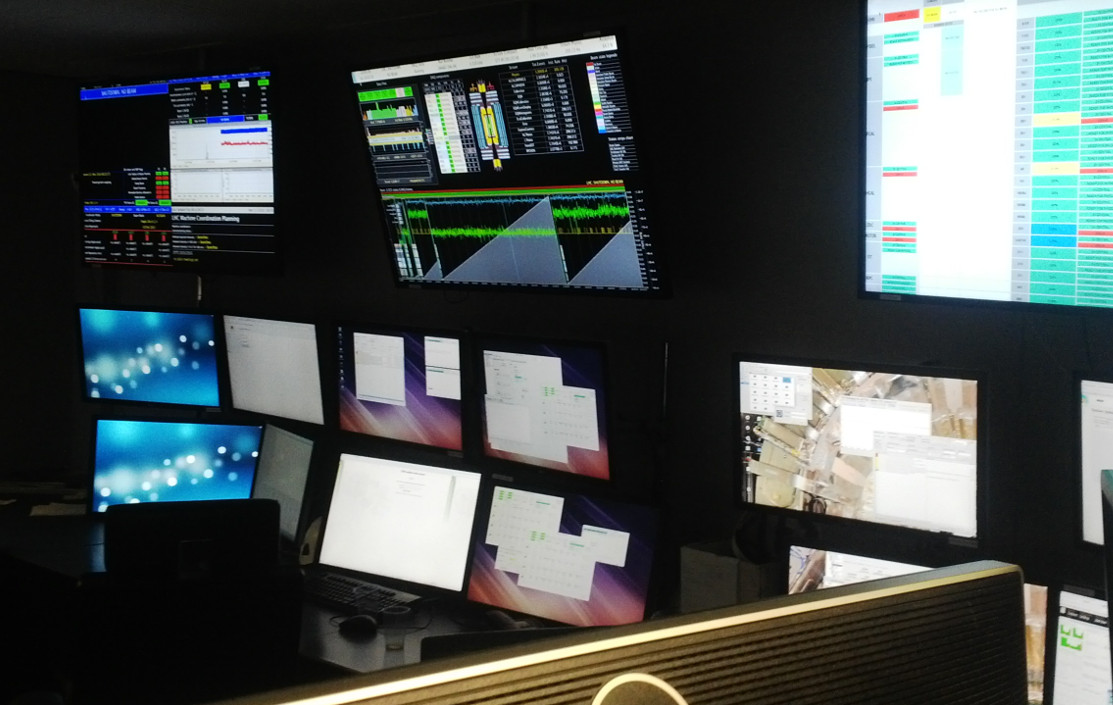
Plasma is for scientists
We usually tend to cater to ordinary users, and computer geeks, and
tend to get excited every time we see a computer screen with KDE
software displayed on some popular TV show or a movie.
But I have to say that all these screenshots that many of us
collected during the years fade a bit in comparison to seeing Plasma
running on most computers in the control centre of the CMS
experiment.