RSI (Repetitive strain
injury) is not an uncommon disorder in the geek world. It can range
from a slight tiredness to a very unpleasant pain.
I don’t know how it should really be treated, but I know two things -
it should not be ignored, and you should not, when you stop ignoring it,
try to relax and rest your fingers by playing guitar after not playing
it for more than a year. Air guitar should be fine if you don’t overdo
it. :)
One of the first things I started doing as a precaution was to switch
the mouse hand every once in a while, and to lessen the number of clicks
by making a no-click application launcher.
The last step I took was a few days ago. Mainly because this summer
is going to be very stressful for my hands, and my fingers don’t seem up
to it at the moment. The last step was to remove the resistance of the
keys on my keyboard. That is, to replace the keyboard with something
else.
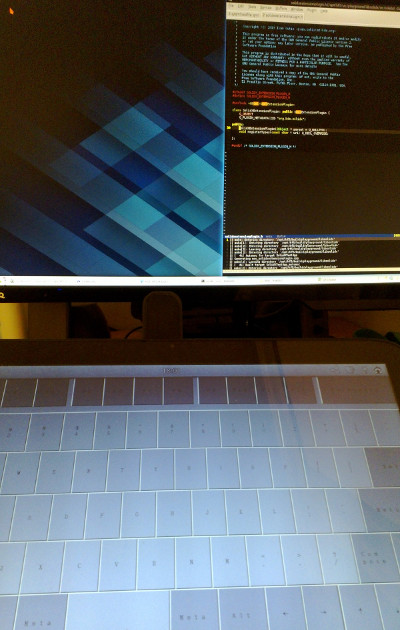
RSIstop
As you can see, I have replaced it with a virtual one (xvkbd) running
on the exopc tablet under plasma active. It controls my main
computer.
I expected it to be quite a productivity killer at first, but it
turned out to be quite a pleasant exercise both for my hands (different
motions, no resistance) and by mind (thinking of the shortest way to
type a variable name by using the fuzzy completion of the vim’s
YouCompleteMe plugin - haven’t typed more than three letters per
variable in a whole day).
All in all, a rather fun setup. The only issue I’m having is that
xvkbd is not meant for multi-touch so if somebody knows of a
full-qwerty+special keys virtual keyboard that can be shown on one
display and control a different one, I’d be much obliged.
Published
in the Prog C++ section,
on 26 June 2013
The last post showed
how to create a modern and safe d-ptr (pimpl) idiom. There were a few
questions regarding the purpose of such a thing, when you can directly
use std::unique_ptr or QScopedPointer. The main reason is that it
provides additional safeguards from abuse by making the interface
minimal. Most importantly, it does not provide an interface to get the
raw pointer. (note: it does, but if you are able and want to write
something like delete d.operator->() who am I to
stop you)
Today, we’ll talk about something evil - singletons. Or, more
precisely, the lesser evil brother of a singleton that lasts only while
someone holds a pointer to it. Again, it is not something that is
difficult to implement, even in old C++, but thanks to the new smart
pointers of C++11 it starts to be more elegant.
In order to have an elegant way of switching plasma shells at
runtime, we need to hide the process from the user. Is there a nicer way
of doing that than showing a pretty splash screen on top of everything?
(this is a rhetoric question - don’t answer, it has already been
decided)
:)
This is aimed at Plasma Workspaces 2 and is pure Qt5/QML2 thingie. It
will also be used as a base for the future versions of KSplashQML (aka
TSP).
Here’s the obligatory looped gif showing what it looks like.
Published
in the Prog C++ section,
on 22 June 2013
The KDE libraries (and some other parts as well) require that the
code uses the so called d-pointer or pimpl (private implementation)
idiom (see [1] and [2]). It makes it easier to keep the ABI unchanged,
and it speeds up the compilation with insignificant runtime costs.
It usually goes like this - declare a Private class and a const
pointer to it named d and (de)initialize it properly.
Instead of having private class members, put them in that class. [2]
-- .h -------------------

class MyClass {
    <font color="silver">:::</font>
private:
    class Private;
    Private * const d;
};

-- .cpp -----------------

class MyClass::Private { <font color="silver">:::</font> };

MyClass::MyClass()
    : d(new Private())
{
    d->name = "I'm a private class member to replace m_name :)";
}

MyClass::~MyClass()
{
    delete d;
}

-------------------------
This works. But having explicit new and
delete operators is generally frowned upon in the
modern C++ world. It is quite easy to forget to add the delete
d to the destructor. And it is nothing more than unnecessary
boilerplate. The example at [1] improves this situation by using the
QScopedPointer which automatically does the deletion
for you.
With the new C++11 features (these are available since gcc 4.4), this
can be made even cleaner.
.h ----------------------

class MyClass {
    <font color="silver">:::</font>
private:
    class Private;
    d_ptr<Private> d;
};
If you realize you don’t like JavaScript as much as everybody around
you seems to, but still want to write platform-independent KWin scripts
or effects, you can try out its most promising alternative - CoffeeScript
The code below creates a KWin effect that fades and zooms in the
windows when a user switches the activities.
Edit: Fixed a small bug. Now it works quite
well!
# Martin G. likes defining variables in a namespace,
# so we are not going to make him angry -
# we are creating a namespace that has only one
# variable in it - the duration

activitySwitchEffect =
    duration: animationTime(250)

# We don't really need anything else in the namespace
# for this simple example since we are about to abuse
# lambdas (aka anonymous functions) all over the place.

# We are connecting our function to the
# currentActivityChanged signal, and processing
# all the main windows we can find

effects.currentActivityChanged.connect (activity) ->
    effects.stackingOrder.map (client) ->
        if (activity in client.activities && client.visible)

            # If the client should be shown in
            # the current activity, we are starting
            # the animations - one to fade the window in
            # and another to scale it.

            animate(
                window: client
                animations: [
                    type:     Effect.Opacity
                    duration: activitySwitchEffect.duration
                    from:     0
                    to:       1
                ]
            )

            animate(
                window: client
                animations: [
                    type:     Effect.Scale
                    duration: activitySwitchEffect.duration
                    curve:    QEasingCurve.OutCubic
                    from:     0
                ]
            )

# And that's it!
Mind that this is only for demonstration - it has a few bugs in it
:)